
A Framework for reducing emissions from buildings
The Zero Carbon Step Code is a provincial framework used by local governments in British Columbia to reduce greenhouse gas emissions from new buildings. It focuses specifically on operational emissions—the emissions produced by heating, cooling, and operating buildings once they are occupied.
Municipalities can choose which level of the Step Code to adopt, and how quickly to move toward higher levels.
What is the Zero Carbon Step Code?
The Zero Carbon Step Code (ZCSC) is part of BC’s building and climate policy framework. It sets performance-based targets for reducing emissions from new buildings, rather than prescribing specific technologies.
Instead of requiring a particular fuel or system, it sets limits on:
- Greenhouse gas intensity (emissions per square metre)
- Energy efficiency and demand
Builders and designers can choose how to meet these targets, using different design and construction approaches.
If you want to see the zero carbon step code adopted soon in Coquitlam – you can sign the petition.
Zero Carbon Step Code vs Energy Step Code: What’s the difference?
British Columbia uses two related but distinct building performance frameworks: the Energy Step Code and the Zero Carbon Step Code. While they are often discussed together, they address different problems.
Energy Step Code (ESC)
The ESC focuses on energy efficiency.
It measures:
- how much energy a building uses
- how well the building envelope performs (insulation, windows, airtightness)
A highly energy-efficient building can still:
- use fossil fuels
- produce significant greenhouse gas emissions
In short:
The ESC reduces energy demand, but not necessarily emissions.
Zero Carbon Step Code (ZCSC)
The ZCSC focuses on greenhouse gas emissions from building operation.
It measures:
- emissions from heating, hot water, and building systems
- long-term operational carbon output
It does not prescribe specific technologies, but emissions limits increasingly favor low-carbon energy sources.
In short:
The ZCSC directly addresses climate impact.
Why Zero Carbon is often treated as a priority
A building can be:
- energy-efficient and high-emissions (e.g., efficient gas heating)
- low-emissions only if carbon intensity is addressed
Because buildings last many decades, operational emissions decisions made today affect climate outcomes for generations. That’s why many governments focus first on carbon intensity, even as energy efficiency continues to improve in parallel.
How the two codes work together
In practice:
- the ESC reduces energy waste
- the ZCSC reduces emissions from the remaining energy use
They are complementary, not competing.
BC municipalities that have adopted the Zero Carbon Step Code (ZCSC)
A growing number of municipalities in British Columbia have adopted the ZCSC ahead of, or beyond, minimum provincial timelines, often with phased implementation.
Examples include:
- Vancouver – zero-emissions building requirements for most new construction
- Burnaby – adoption of ZCSC requirements for new buildings
- New Westminster – implementation of ZCSC standards
- Richmond – phased adoption aligned with provincial targets
- North Vancouver (City & District) – early adoption of low-carbon building requirements
- Surrey – adoption for certain building types through step code pathways
Many municipalities apply different levels by building type, with higher standards often introduced first for larger (Part 3) buildings.
Implementation details, timelines, and building types vary by municipality and are typically set out in local bylaws and staff reports.
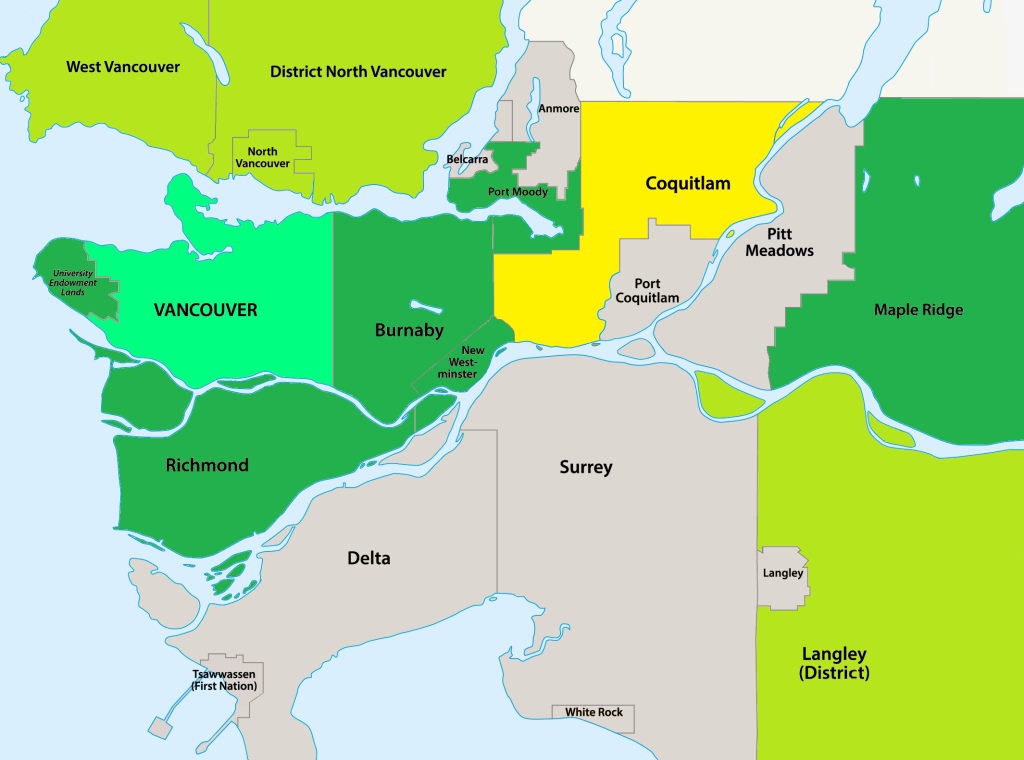
The map below shows the various municipalities that have adopted the ZCSC, with Coquitlam in yellow indicating that they are close to adoption.
What the Zero Carbon Step Code (ZCSC) is designed to do
The ZCSC is intended to:
- Reduce long-term emissions from new buildings
- Avoid locking in high-emission systems for decades
- Give industry a predictable pathway to higher standards
- Allow local governments to phase in requirements over time
- It applies to new construction, not existing buildings
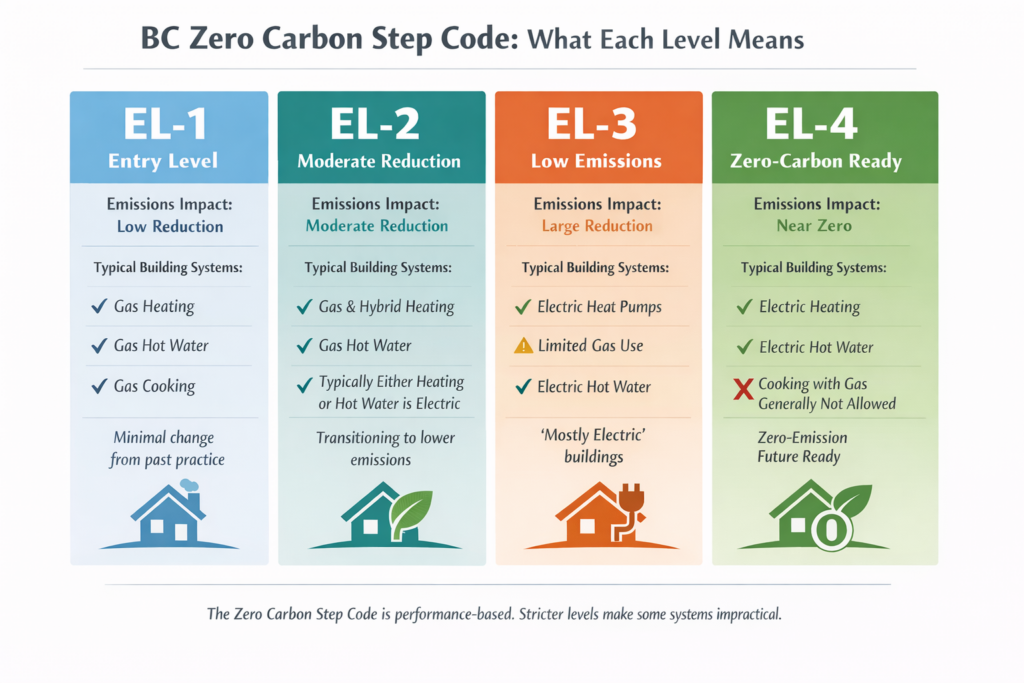
What each level of the Zero Carbon Step Code (ZCSC) levels mean in practice (by technology)
The ZCSC is performance-based, not technology-based. It does not explicitly ban specific fuels or appliances. However, as emissions limits become stricter, some technologies become difficult or impractical to use while still meeting the required performance level.
The table and explanations below describe what is typically compatible at each level, based on how buildings are commonly designed to meet the emissions targets.
EL-1 — Entry level
Typical compatibility:
- ✔ Gas space heating
- ✔ Gas hot water
- ✔ Gas cooking
- ✔ Gas fireplaces
- ✔ Gas barbecues
At this level, most conventional building systems can still meet the emissions limits. EL-1 generally represents a modest improvement over past practice.
In practice:
Little change from traditional gas-heated buildings.
EL-2 — Moderate emissions reduction
Typical compatibility:
- ✔ Gas space heating (often with efficiency improvements)
- ✔ Gas hot water (sometimes combined with efficiency or hybrid systems)
- ✔ Gas cooking
- ✔ Gas fireplaces (may be limited or require higher efficiency)
- ✔ Gas barbecues
At EL-2, gas systems may still be used, but designers often need to offset emissions through better insulation, more efficient equipment, or partial electrification. Usually they will need to choose between gas heat and gas hot water.
In practice:
Gas remains possible, but design flexibility starts to narrow.
EL-3 — Low-emissions buildings
Typical compatibility:
- ⚠ Gas space heating (generally difficult to justify without offsets or hybrid systems)
- ⚠ Gas hot water (generally replaced with electric heat pump systems)
- ✔ Gas cooking (usually still permitted, as it is a small share of emissions)
- ✔ Gas fireplaces (usually allowed as the decorative or non-primary source of heat)
- ✔ Gas barbecues (generally unaffected, especially if outdoor)
At EL-3, operational emissions limits are tight enough that most projects shift to electric heat pumps for space and water heating. Gas may still be present in limited or accessory uses, but it becomes harder to accommodate major gas systems.
In practice:
Buildings are typically “mostly electric,” even if not fully gas-free.
EL-4 — Zero-carbon ready
Typical compatibility:
- ✖ Gas space heating (generally incompatible)
- ✖ Gas hot water (generally incompatible)
- ⚠ Gas cooking (may be allowed in limited circumstances, depending on design and local policy)
- ✔ Gas fireplaces (usually allowed as the decorative or non-primary source of heat)
- ✔ Gas barbecues (typically allowed if outdoor and not part of building systems)
EL-4 represents near-zero operational emissions. To meet this level, buildings almost always rely on:
- electric heat pumps
- very high-performance building envelopes
- low- or zero-emission energy sources
On-site combustion for major building systems is typically not compatible with this level.
In practice:
New buildings are designed to operate without fossil fuel heating systems and will possibly be built without natural gas supply to the building at all.
Important clarifications
- The Zero Carbon Step Code does not regulate personal appliances inside existing homes.
- Outdoor features such as barbecues are usually not regulated as part of building emissions, especially when not connected to permanent building systems.
- Final requirements depend on:
- building type (Part 3 vs Part 9)
- local government implementation
- compliance pathways used by the designer
Why this distinction matters
Understanding the practical implications helps explain why:
- lower levels involve minimal change
- higher levels push buildings toward electrification
- debates often focus on heating systems, not cooking or barbecues
The Zero Carbon Step Code is designed to address the largest and longest-lasting sources of emissions, particularly space and water heating, which dominate building energy use over decades.
No. It is performance-based. However, at higher levels, emissions limits make some gas systems difficult or impractical to use.
No. It applies to new construction, not existing buildings.
Cooking with gas is generally compatible at lower levels, often still allowed at EL-3, and typically not compatible at EL-4 due to emissions limits.
The Energy Step Code focuses on efficiency, while the Zero Carbon Step Code focuses on emissions.
Yes they are typically allowed as the code does not regulate secondary heating sources.
For background on how building and land-use decisions are made locally, see How zoning and housing decisions work in Coquitlam
This page is intended as a factual backgrounder on the Zero Carbon Step Code and does not advocate for a specific policy outcome.